


The Monument
Commission · London’s bicentennial
The Silverwoods monument
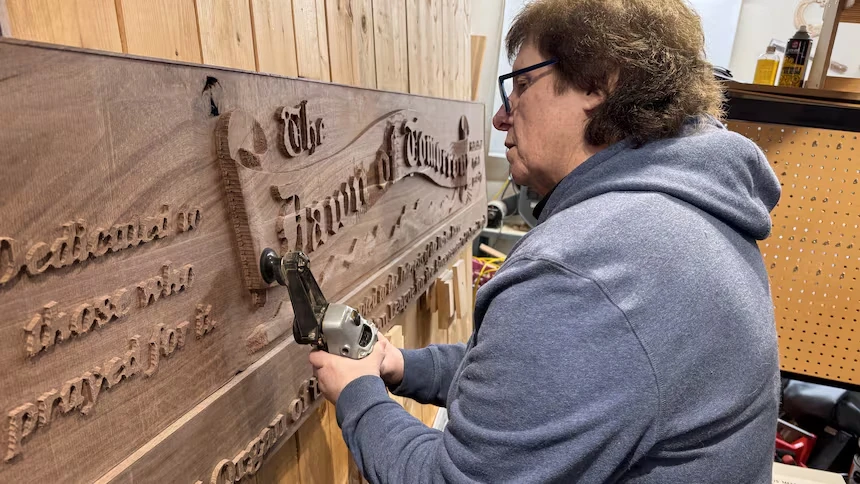
London turns two hundred this year. As part of the bicentennial programme I am carving a tribute to six people from the city’s Black history, in partnership with Robin Armistead at the City of London. The finished piece is to be installed at the newly renovated Silverwoods Community Centre.
Who is in it
James and Christina Jenkins started the Dawn of Tomorrow in 1923. When slavery was abolished, people who had come from the south were free to go wherever they wanted, and James saw that the community needed to hold together and to communicate. The paper served Black readers in Canada and in the northern United States. James will be at his typewriter, with Christina standing behind him, her hand on his shoulder.
Barry Howson was Christina’s ninth child — something people did not know at first, because they knew him as an Olympic basketball player and the first Black person on Canada’s 1964 Olympic team. He was a multi-sport athlete. He is carved mid-jump, ten feet in the air. He is still alive, and I have met him five times. He is a sweetheart.
Stan “Gabby” Anderson was an all-star seven times, on the best teams in London, and is ranked among the top London majors of the last hundred years. I spoke to two of his teammates and they think he was the best of them. When people talk about Gabby Anderson their whole expression changes. He is carved batting.
Harry Corsi is not well known, but he was close to Barry Howson in athleticism. He nearly became an Olympian in track, and he was a very good baseball pitcher. He is carved ready to run.
Kay Livingstone — James and Christina’s daughter — is a legend. How she is presented is being decided by Michelle Jenkins, granddaughter of the founders of the Dawn of Tomorrow.
Why the newspaper matters
The only records we seem to have are those of the Dawn of Tomorrow. Otherwise, all of the achievements, all of the great things that people did wouldn’t be available. It was a way of documenting, and I think they had a huge vision about this. It wasn’t just the newspaper, it was definitely a message.
The families of Hamilton Road — the Jenkinses, the Andersons, the Moxleys — are the reason the piece exists.
Once you put oil on it, it comes alive. There are hours and hours in this carving, but in the end it is going to be magnificent.
This is them. That belongs to them. If we can show their legacy for the people who are currently living there, we’ve done our job.
Quotations and the photograph above are from CBC News London, “Q&A: This wood artist is carving out a monument for some of London’s Black pioneers,” by Matt Allen, 22 March 2026. Read the full interview.